| HEMPOLOGY.ORG: THE STUDY OF HEMP
|
|||
|
|
||
Source: Cordage and cordage hemp fibers
Author: T. Woodhouse and P. Kilgour
Pages: 12-15
Printed in 1919 by Sir Isaac Pitman & Sons, Ltd.
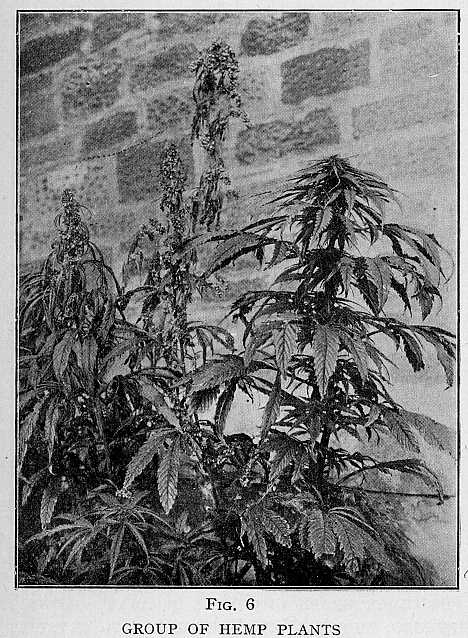
The second source from which fibre is extracted is that from the stems of plants such as flax, hemp, jute and the like. A photographical reproduction of a group of hemp plants grown by the Authors appears in Fig. 6. A female plant is illustrated on the right, while the remaining two which are taller are male plants.
A thin cross-section cut from the stem of such a plant exhibits the characteristics in Fig. 7, in which A is the cuticle or outer bark, B is the woody part, and C the pith. The fibrous layer is between the two dark circles D, and a few groups of fibres in this layer are indicated by the letter E. Here, again, a considerable amount of extraneous matter must be separated from the bast layer, and when separated, the latter appears in the form of long ribbons. The cuticle and bast layer were originally stripped from the plants; the former were then placed in the mouth so that the saliva could aid in the separation of the fibrous layer to produce finer threads. And although at the present time this method is practised for thread making in many primitive communities, it need hardly be said that much more efficient methods have long been practised for commercial purposes, such methods being known by the technical terms "retting," "breaking," and "scutching."
